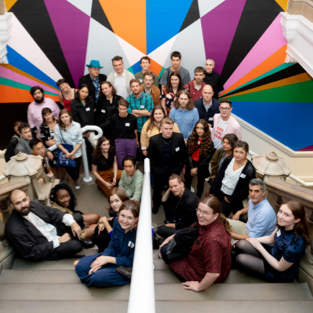
Artist Asuf Ishaq reflects on his two-week New Contemporaries residency with Hospitalfield in Arbroath, and shares tips for emerging artists developing their own practice.
10 June 2025
During my residency at Hospitalfield, I had time to think through my ideas for some new work. Earlier in the year, I visited my abandoned family home in Pakistan. I gathered a large amount of digital material, mainly sounds of resonance in rooms, spaces, and surfaces of the building, and captured still images and 3D scans of the space.
The recording will be the basis for a new work, which explores sonic archives, excavating spaces and resonance.
Sound recorder and 3D scans of spaces in the house in Pakistan
“I am examining ideas of home, a place where memories have been embedded and sit dormant in the spaces, rooms and materials of the edifice.”
I am interested in the body; living spaces and geographical location; the resurrection or the remaking of something that is lost; the end of a period and start of a new one. I want to activate the spaces, the ambience and the resonance of the house. Sound has a unique quality as an energetic, dimensional medium and it operates sculpturally. I began exploring this by making paper maquettes. These memorable family spaces will be inflated sculptures of spaces and rooms.
I captured physical spaces and the resonance of rooms, courtyards, and staircases by ‘activating’ the space using the sound of a popping balloon to portray the signature of the space, sonically. I began to experiment with musical notes using my mini keyboard. The captured signature made into an echo or a reverb which I can apply to other sounds. Here I assigned the reverb to musical notes, different rooms and spaces, and began to compose musical gestures and superimpose the recordings of my body moving in the house. I generated this in a sound application called Abelton Live on my computer, building convolution reverb.
Each morning I would walk to the beach, which was only 20 mins away. I walked along the sand for a short time to gather my thoughts for the day or listened to some music. A few of the other residents would go swimming in the freezing sea early in the morning, I did not manage to join them. Each day was productive, I could focus without the usual daily distractions of life.
“Sharing my residency with other artists and writers was fruitful, hearing different perspectives about my practice and learning about theirs. There was a sense of kindness and support for one another.”
By organising my material and playfully testing out ideas, I have expanded my ideas to multiple works, a surround sound installation and a sculpture piece. My intentions are to continue working on these projects for the coming months, and present my work in an exhibition later this year.
Top tips for emerging and early career artists considering a residency
I found it useful to think about what I wanted to achieve during my residency, to make the most of my time. I had a plan to complete some tasks but kept time for playful experimentation. I took my small portable piano, paper, headphones, hard drive of recordings and my computer.
You may want to consider the type of residency you need, research time or production time, and check for the types of facilities they offer. Hospitalfield have great studios, digital studio, a projection room for films and presentations, a photography darkroom and spaces for performance practice.
This was my first interdisciplinary residency, sharing it with a group of diverse creatives. I enjoyed the social aspect of the residency too, but if you need a quiet time there are lots of quiet spaces in the house to read and work, and there is no pressure to socialise. This residency works for everyone.
Make your residency an enjoyable time.
Find out more about the New Contemporaries Residency Programme here.
Previous Story
Blog: Millie Shafiee, 2024 NC artist